

You’ve invested in a great-looking website. It loads fast, it’s mobile-friendly, and the layout seems modern. But the conversions? Still disappointing.
Sound familiar?
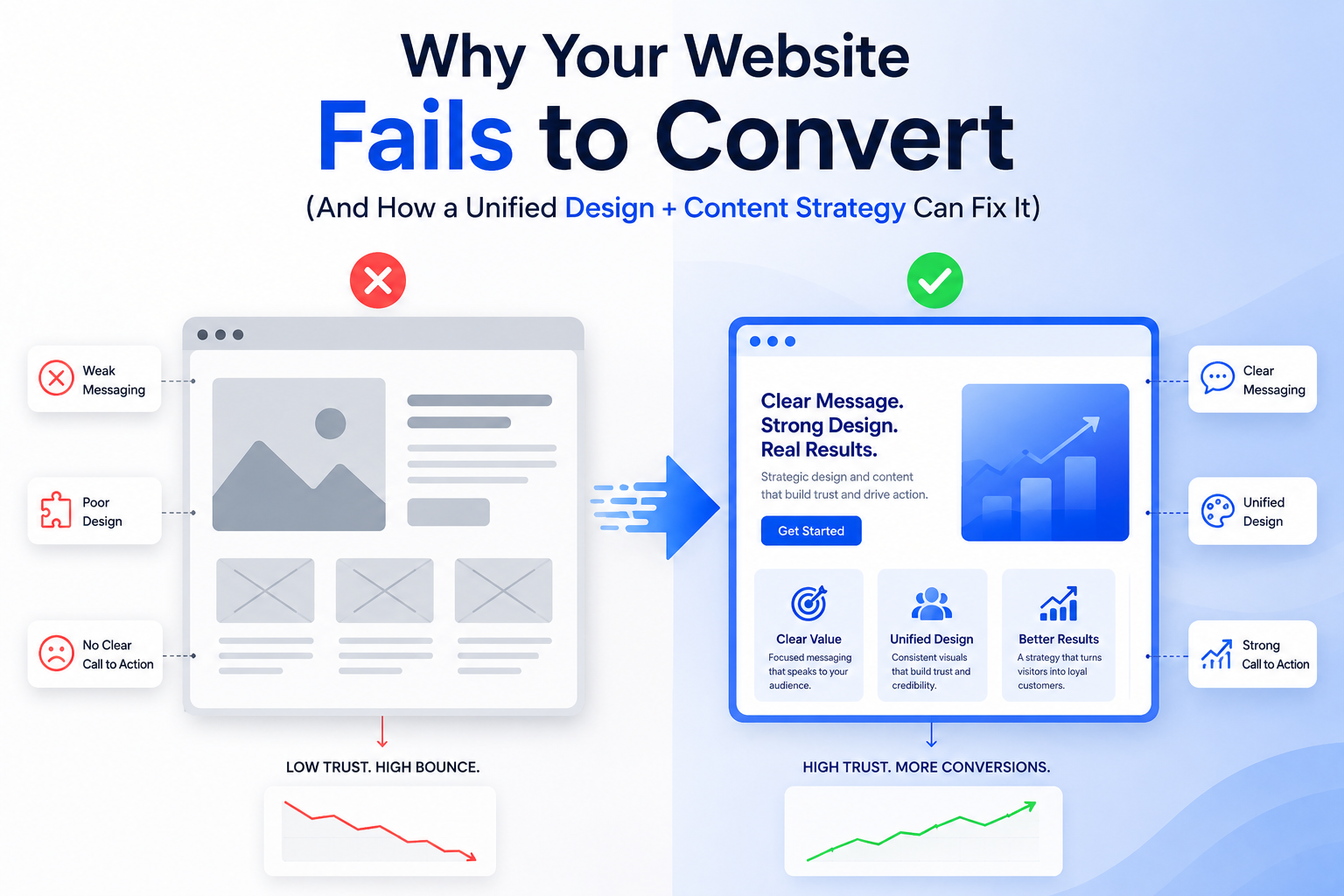
The problem might not be your visuals or your offer — it’s the disconnect between design and content. In too many websites, UI/UX and copy are treated as separate silos. But in today’s digital space, your words and your visuals need to work in unison to drive user action.
Let’s explore why your site may be failing — and how a unified strategy between design and content can transform your results.
1. Pretty Doesn’t Mean Persuasive
Yes, users judge websites in milliseconds — but those judgments go beyond color palettes and fonts. If your website looks good but doesn’t guide action, it becomes just a digital brochure.
Effective websites are:
- Clear, not just clever
- Purposeful, not just pretty
- Functional, not just fashionable
You need a structure that flows like a story — and copy that supports each visual cue.
2. Your CTA is Lost (Or Worse — Confusing)
One of the biggest reasons for low conversion is weak or buried Calls-to-Action.
Ask yourself:
- Is the CTA visible without scrolling?
- Does it match the user’s journey on the page?
- Is the microcopy specific and benefit-driven?
Design should highlight the CTA using whitespace, color contrast, and hierarchy — while the content should clarify why the user should click.
3. There’s No Visual Hierarchy Guiding the Reader
If every headline screams for attention or every block looks the same, users don’t know where to focus. They skim and leave.
Unified design + content solves this by:
- Using typographic scale to separate primary vs secondary messages
- Creating scannable content blocks with strong headlines
- Designing visual anchors (icons, illustrations, section dividers) that guide progression
When content and layout are designed to work together, users stay longer — and convert more often.
4. You’re Saying Too Much (or Too Little)
Too much copy overwhelms. Too little copy leaves questions unanswered.
A unified strategy finds the sweet spot by:
- Mapping each section of the site to a user intent
- Using design to chunk long content into digestible formats
- Writing microcopy (tooltips, button labels, error messages) that reassures and supports
The best sites feel light but informative — because every word and pixel has a role.
5. It’s Not Mobile-First — It’s Mobile-Second
Google penalizes poor mobile UX — but so do users.
If your mobile site:
- Forces users to pinch and zoom
- Uses massive images that slow things down
- Buries key content below long scrolls
…you’re losing conversions daily.
Mobile-first design paired with compact, high-impact copy is essential. The content should prioritize action. The design should eliminate distractions.
6. Trust Signals Are Missing or Misplaced
Would you buy from someone who gives you no proof?
Design needs to make trust elements stand out:
- Reviews and testimonials (with faces and names)
- Logos of brands you’ve worked with
- Press mentions or certifications
- Human-centered content like a team photo or founder story
A content strategist ensures these don’t just exist — they’re woven into the flow. A designer ensures they’re seen.
7. There’s No Emotional Hook
Conversion isn’t just logic — it’s emotion.
If your design is sterile and your copy is generic, there’s no story to connect with. Your site should answer:
- Why does this brand care?
- What does it feel like to use this product or service?
- Why now?
Emotionally resonant messaging, paired with warm, intentional design choices, creates moments that move users.
When content and design are built in silos, you get something that’s just okay.
But when they come together with shared goals, clarity of messaging, and intent-driven layouts — you get a conversion machine.
That’s why the best-performing websites today aren’t just “well-designed.” They’re well-composed.
So if your site isn’t converting, it’s time to stop asking what’s broken — and start asking whether your design and content are truly working together.