

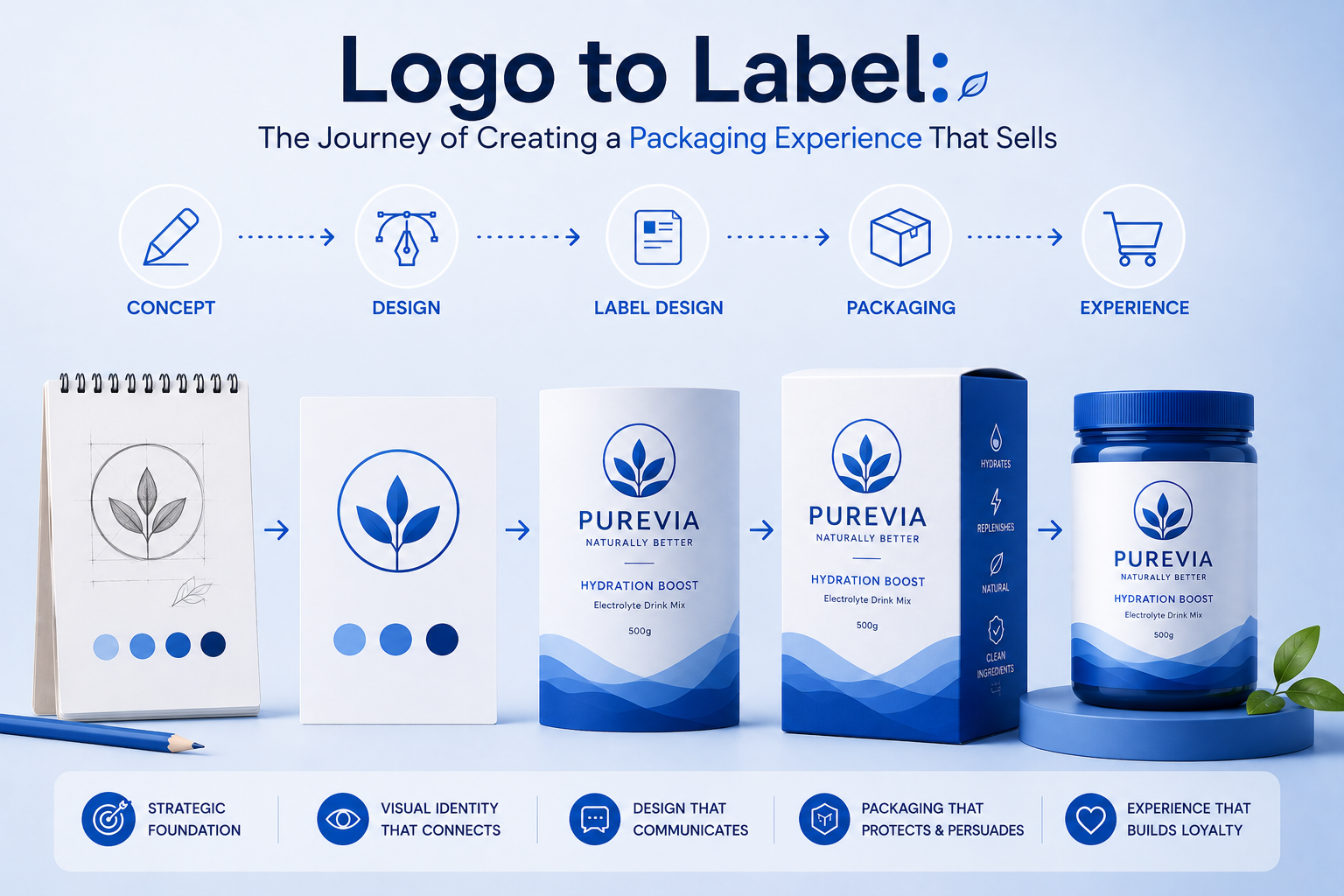
In the sea of product shelves — both physical and digital — packaging is more than a container. It’s a handshake. It’s a billboard. It’s the only salesperson your product has before someone even tries it.
While a strong logo builds recognition, it’s the full packaging experience that builds desire, emotion, and trust. From dielines and finishes to typography and storytelling, every inch of your label is a chance to sell without saying a word.
So how do we go from a flat logo file to a full-blown packaging identity that moves off shelves?
Let’s walk through the journey.
Packaging isn’t just about “looking good.” It’s about understanding:
- Who you’re selling to
- Where the product will sit (online, retail shelf, luxury boutique?)
- What emotion you want to trigger
Before a designer opens Figma or Illustrator, we define positioning. Is your brand playful? Premium? Purpose-driven? Sustainable? That clarity determines every creative choice moving forward.
Your logo may look great on a website or business card — but can it scale down to a tiny label? Can it work in foil or embossing? Does it hold up in monochrome for regulatory print applications?
A good packaging system includes:
- Primary logo lockup
- Stacked or horizontal variations
- Monogram or icon versions
Adaptability ensures brand consistency across formats — from pouch to bottle to shelf-ready box.
Every product comes with constraints: size, shape, surface, material. Your dieline is the blueprint of that surface.
Think of dielines as the stage for your design. It includes:
- Bleed areas
- Safety margins
- Fold/crease marks
- Regulatory compliance zones (especially for food, cosmetics, or pharma)
Designing within — and often creatively around — these boundaries is the difference between amateur packaging and professional shelf appeal.
Colors and fonts don’t just decorate — they communicate.
- Earth tones + serif fonts = eco-conscious, organic
- Bright pastels + rounded fonts = youthful and friendly
- Monochrome minimalism = luxury and premium positioning
The typeface hierarchy (headlines, body copy, product descriptors, net weight) should feel natural to read — and aligned with your brand’s tone.
Legally, your packaging must include a lot of info — ingredients, barcodes, instructions, batch numbers.
But the challenge is making this functional data look elegant.
Use:
- Icons for instructions
- Grid layouts to organize info cleanly
- QR codes for extended storytelling or product origin tracking
- Design-led back panels that don’t feel like afterthoughts
Information should never feel like a distraction — it should enhance trust.
How a product feels in someone’s hand affects how they perceive it.
Options include:
- Matte vs gloss finish
- Embossing/debossing
- Foil stamping
- Sustainable or recycled stock
- Minimal ink for a raw, natural feel
Packaging is tactile branding. Make it worth the touch.
Once the design is ready, we test:
- 3D mockups in real-life scenarios
- Shelf comparison against competitors
- Distance readability — can someone recognize the brand from 3 feet away?
This testing ensures your packaging not only looks good up close, but also performs in a fast-paced buying environment.
Your logo starts the conversation. Your label continues the story. The entire packaging experience — from unboxing to recycling — shapes the brand memory.
In today’s world, where social sharing, sustainability, and sensory delight are expected — packaging isn’t the end of branding. It’s often the most visible beginning.