

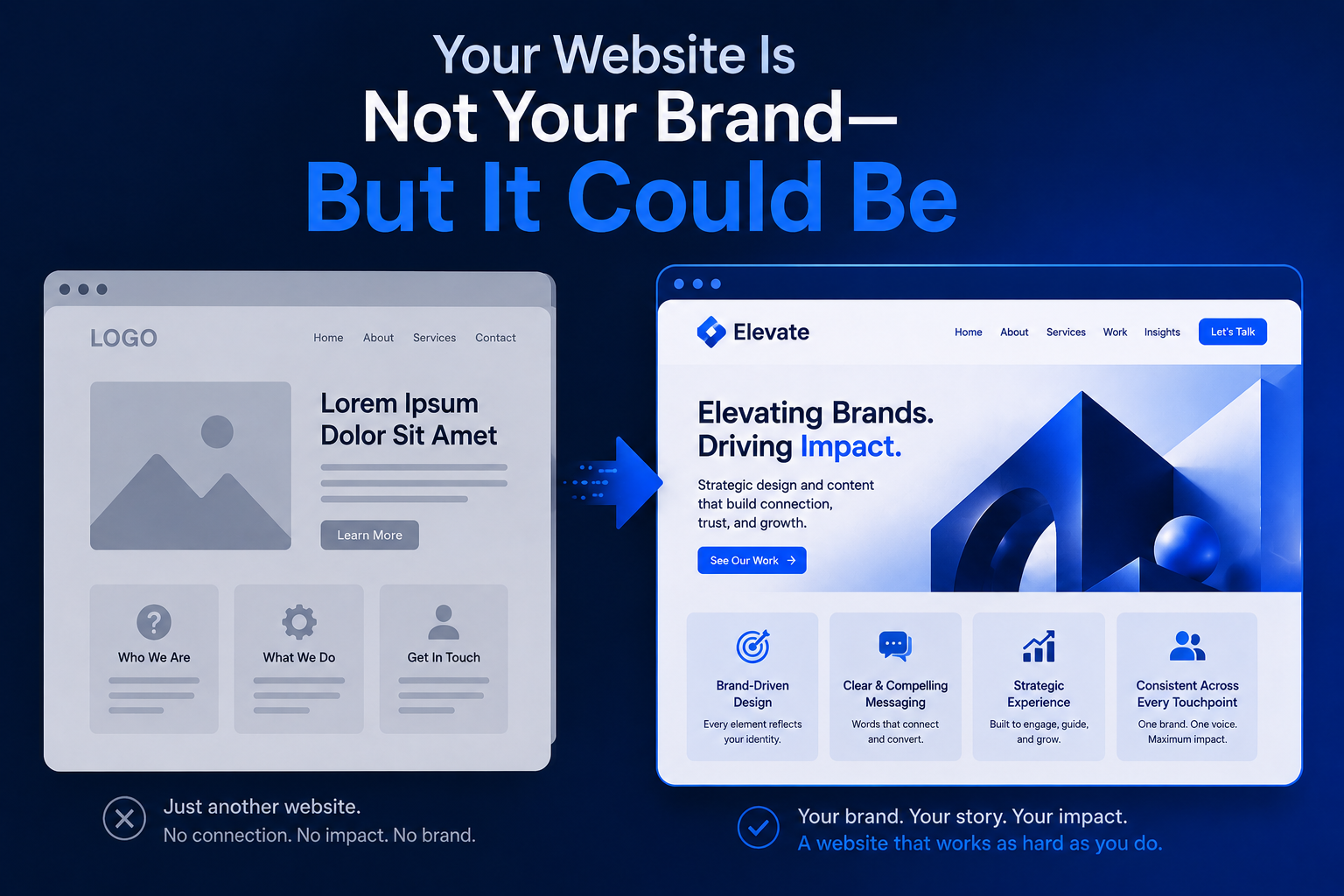
Let’s get one thing straight:
Your website isn’t your brand.
But in most cases, it’s the first and most frequent interaction someone has with your brand.
So, while your brand is much more than just a website — a combination of voice, values, visuals, product, and personality — your website is where all of it either comes alive or falls apart.
That’s why a strong brand isn’t just communicated through visuals; it’s experienced through your website.
Let’s break down the gap between “website” and “brand” — and how to close it.
1. Your Website Is a Stage — Your Brand Is the Script
Think of your website as a stage.
The design, layout, colors, and animations? That’s the set.
Your content and interactions? That’s the dialogue.
But what story are you telling?
Without a clear brand strategy, even the best website feels hollow. And without a strong web presence, even the best brand feels invisible.
You need both:
- Branding to define what you stand for
- Web design to express it through experience
2. A Branded Website Feels Consistent Across Every Scroll
One of the most overlooked conversion killers is inconsistency.
Does your home page feel premium but your About page looks like a 2015 Word template?
Does your copy tone shift from playful to corporate without reason?
Brand-driven websites ensure:
- Tone of voice remains unified across all content
- Typography and spacing follow set guidelines
- Color and imagery reinforce emotions and values
- Microinteractions (like button hover or scroll effects) reflect brand personality
A consistent experience doesn’t just look better — it feels more trustworthy.
3. When Branding Guides UX, You Get Better Business Results
Branding isn’t just aesthetic. It should influence how your website behaves.
For example:
- A bold, youth-oriented brand might use oversized text, bold CTA buttons, and punchy headlines.
- A luxury skincare brand might lean on soft motion, delicate typography, and fewer words with more space.
Good branding gives direction to UX:
- What should feel fast?
- Where should users pause?
- What emotion should each scroll section evoke?
When users feel emotionally aligned with a site, they spend more time and trust the offer faster.
4. Design Without Brand Is Decoration
Many websites look good — but feel empty.
Why? Because design was done in isolation.
There was no brand compass. No story. No “why.”
Great branded websites ask:
- What’s our mission, and how do we reflect it on this page?
- What’s our tone — humorous, warm, edgy, clean?
- How should the user feel at the end of this scroll?
This alignment is what turns visitors into fans — and eventually, customers into advocates.
5. The Best Websites Feel Like Walking Into a Store
Ever walked into a store and instantly felt what the brand stood for?
That’s what your website should feel like:
- Immediate clarity on what the brand does
- Familiar design elements from the packaging, social media, and ads
- Emotionally resonant copy that mirrors your brand voice
- Clear flow — like having a good store attendant guide you
Whether your site is a D2C product page, a SaaS homepage, or a service portfolio — it should offer the same vibe and values as the rest of your brand ecosystem.
6. So, Can Your Website Become Your Brand?
Not entirely — but it can and should carry your brand forward.
In today’s digital-first world:
- Your website is your first pitch
- Your social media is your small talk
- Your product or service is your promise
- Your follow-ups are your reputation
Your website isn’t the brand.
But it’s the strongest delivery vehicle you have to communicate it — clearly, consistently, and confidently.
When done right, your website doesn’t just describe your brand —
it embodies it.
So instead of asking, “How should the website look?” —
Start asking, “How should the website feel like our brand?”
Because that feeling is what sticks. That’s what converts.
And that’s how your website becomes a true expression of your brand.